

Breast Lift vs Implant: Which Is Right for You?
By Partington Plastic Surgery on May 21, 2026 in Breast Implants, Breast Lift

One of the most common questions we hear in consultation goes something like this: “I want my breasts to look the way they did before kids – or before time did what time does. Should I get a lift, implants, or both?”
It’s a great question. And the honest answer is that breast lift vs implant isn’t really a competition – they solve fundamentally different problems. Patients searching for answers about breast lift vs breast implant options often assume one is universally “better” than the other. That’s not how it works. Understanding which problem you’re actually trying to solve is the key to choosing the right procedure, getting results you’ll love, and avoiding a revision down the road.
Here’s how we think about it.
The Core Difference: Volume vs. Position
Here’s the most important thing to understand when comparing breast lift vs implant options:
Implants add volume. A breast augmentation – whether with implants or fat transfer – makes the breast larger, fuller, and more projected. It does not change where the breast sits on your chest, and it does not move your nipple.
A lift changes position and shape. A mastopexy (the technical term for a breast lift) removes excess skin, reshapes the breast mound, and repositions the nipple and areola to a higher, more youthful location on the breast. It does not significantly add volume – in fact, it often removes a small amount.
When patients ask “breast implant vs lift – what do I need?” the first thing we look for is ptosis, which is the medical term for drooping. Ptosis is the central variable in this conversation. Understanding your degree of ptosis determines whether you need a lift, implants, both – or whether implants alone might do the job.
Understanding Ptosis: The “Drooping” That Determines Your Path
The real question at the center of the breast lift vs implant decision is whether you have ptosis – drooping – and how much.
Ptosis isn’t just about looking “saggy.” It’s a clinical measurement based on where your nipple sits relative to the inframammary fold – the natural crease beneath your breast.
There’s a quick self-assessment you can try at home. It’s sometimes called the “banana test”: place a pencil in the crease under your breast and let it rest there. If the pencil stays held without effort – meaning your breast tissue has folded over it – you likely have some degree of ptosis. The question is how much.
Surgeons classify ptosis on a scale:
- Grade 1 (Mild ptosis): The nipple is at or just slightly below the fold. The breast has begun to descend, but the nipple is not drooping significantly.
- Grade 2 (Moderate ptosis): The nipple is below the fold, sitting lower on the breast mound.
- Grade 3 (Severe ptosis): The nipple has descended well below the fold and points downward. This is the most significant degree of drooping.
Mild ptosis is sometimes correctable – or at least significantly improved – with augmentation alone. For Grade 2 and Grade 3, a lift is almost always necessary to achieve the result patients are hoping for.
The Biggest Misconception We Hear in Consultation
“Can’t I just get implants? Won’t they lift my breasts?”
This is one of the most persistent myths in plastic surgery, and we want to be direct about it: implants do not lift a drooping nipple. They can fill and project the breast, which can make mild sagging less noticeable, but if your nipple is below your fold, it will remain below your fold after augmentation. The breast will simply be larger with a nipple that’s still in the wrong position.
Patients who get implants hoping to correct significant ptosis often end up disappointed – and eventually return for a lift they needed from the start. In the breast lift vs implant conversation, being honest about this upfront saves a second surgery later.
That said, for the right patient – someone with minimal ptosis who primarily wants more volume and fullness – implants alone produce beautiful, lasting results without any lift at all.
Natural Look
Confident Beauty
24 Hour Rapid Recovery, Muscle Sparing.

Who Needs Only Implants?
In the breast lift vs implant comparison, implants are the right answer when your breast position is already good and your primary concern is volume.
If you have minimal or no ptosis, and your primary concern is volume, implants alone are likely the right choice.
This typically describes:
- Younger patients who have always wanted more fullness
- Women whose breast tissue has always been small relative to their frame
- Patients with modest deflation where the nipple is still in an appropriate position
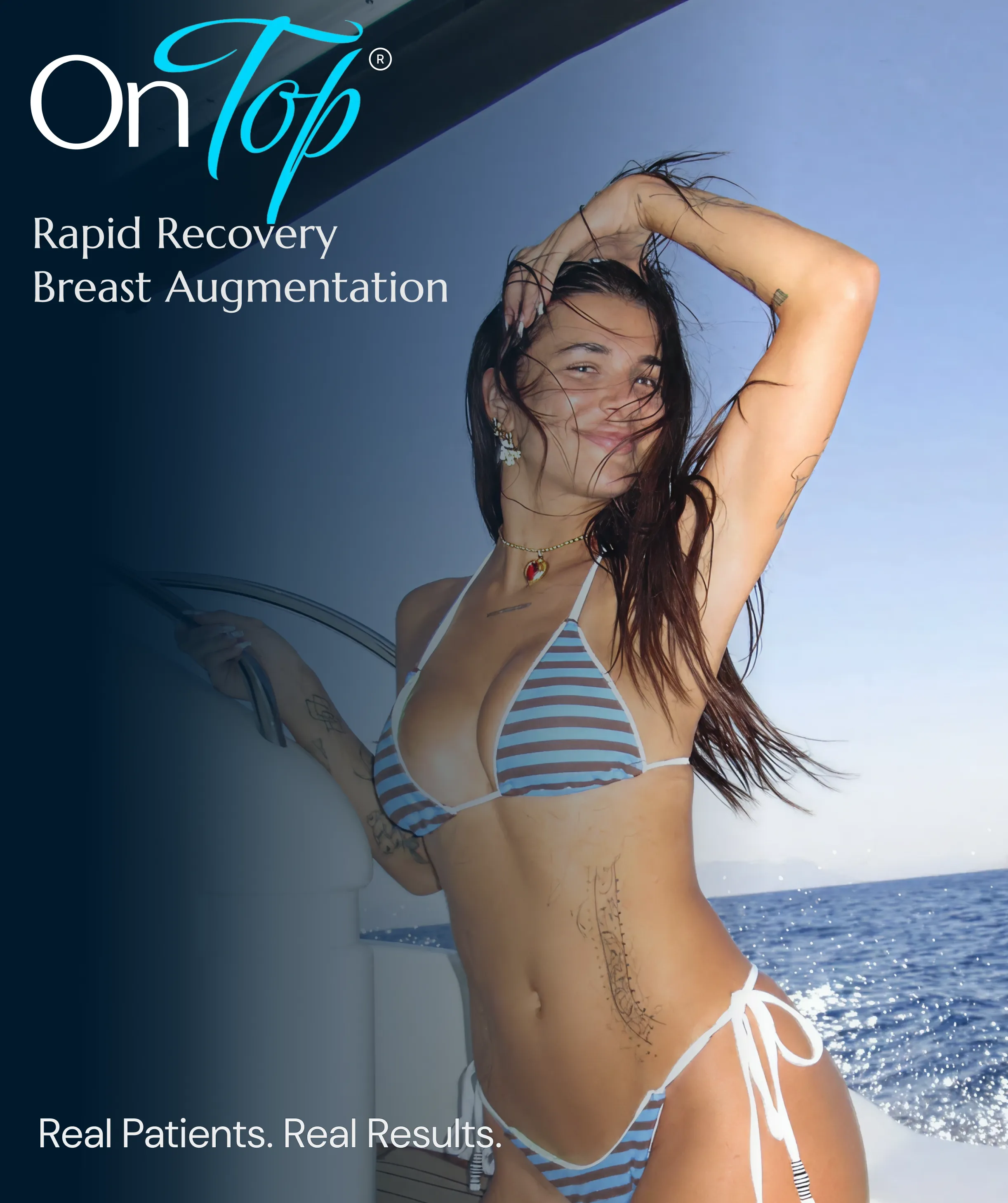
For these patients, the goal is simply adding volume and projection – and implants do that beautifully. The On Top® Rapid Recovery Breast Augmentation is particularly well-suited to this group: supramuscular placement, 24-hour recovery, no narcotic pain medication. We use only Motiva® sixth-generation silicone implants, which feature an Ergo® design that moves naturally with the body and a 0.6% capsular contracture rate – far below the industry average of 4%.
For patients who prefer not to use implants at all, fat transfer breast augmentation is a compelling alternative, providing a natural half-to-one cup increase using your own tissue.
Who Needs Only a Lift?
On the other side of the breast lift vs implant equation: if you have good volume but your breast position has dropped, a lift is what addresses the problem – not implants.
If you have good breast volume – or even feel your breasts are the right size – but are bothered by drooping, a breast lift (mastopexy) may be all you need.
This often describes:
- Women after breastfeeding whose breasts deflated and then partially re-filled
- Patients who have lost significant weight
- Women in their 40s–60s whose skin has stretched over time
The breast lift procedure removes the excess skin that allows the breast to droop, reshapes the breast tissue, and moves the nipple to a higher, more youthful position. It does leave scars – the pattern depends on the degree of ptosis:
- Periareolar (donut): A scar around the nipple only, appropriate for mild ptosis
- Lollipop: A scar around the nipple and vertically down the breast, for moderate ptosis
- Anchor (inverted T): The most comprehensive option for significant ptosis, with scars around the nipple, vertically down, and along the fold
The trade-off – improved position and shape in exchange for some degree of scarring – is one most patients feel is well worth it. Scars fade significantly over time, and they’re hidden under most clothing and swimwear.
Who Needs Both: The Combination Approach
For many women – especially those asking “do I need a lift or implants?” after pregnancy – the answer is both, because they have two separate issues that require two different solutions.
After pregnancy and breastfeeding, many women experience both volume loss and drooping. The breasts that were full during nursing have deflated, leaving looser skin and a nipple that’s dropped below its former position. In these cases, doing mastopexy vs augmentation as separate procedures and choosing one misses the point – both problems need to be addressed.
Breast lift and implants together give patients improved position (from the lift) and restored fullness (from the implant). When performing this combination, Dr. Partington uses the On Top® technique for the augmentation component. Because On Top® is a supramuscular placement – meaning the implant goes above the muscle, not beneath it – there’s no muscle dissection involved. This matters when combining with a lift: less tissue disruption means a smoother recovery, lower surgical complexity, and more predictable results.
The combined approach typically involves a slightly longer recovery than either procedure alone, but the results – addressing both ptosis and breast augmentation in a single operation – are transformative for patients who’ve been living with post-pregnancy or post-weight-loss changes.
A Note on Ptosis and Breast Augmentation with Implants
For patients with mild Grade 1 ptosis who want more volume, there’s a middle ground worth discussing. The increased projection from an appropriately sized implant can push the breast forward enough that the nipple appears to sit higher relative to the breast mound – a visual improvement that, for mild cases, may be sufficient.
This works best when the nipple is at or just barely below the fold. The key word is mild. Implants can flatter mild drooping, but they can’t correct it structurally. If your nipple is significantly below the fold, placing implants without a lift will result in a larger breast with the nipple still in the wrong position – what surgeons sometimes call a “Snoopy deformity.”
During consultation, we assess this together. Dr. Partington will measure your degree of ptosis, review your goals, and provide an honest answer about what each approach will and won’t accomplish for your specific anatomy.

The Role of Motiva® Implants in Natural Breast Lift vs Implant Results
When advising patients on the breast implant vs breast lift decision – or recommending a combination – implant selection still matters enormously.
We use Motiva® sixth-generation silicone implants exclusively at Partington Plastic Surgery. The Ergo® design follows the natural slope of the breast, fuller at the base and tapered toward the upper pole, which means the result looks like natural breast tissue rather than an obviously augmented shape. For patients considering ptosis and breast augmentation together, a natural-looking implant is especially important – the goal is a breast that looks appropriately full and well-positioned, not a round, implant-visible appearance.
The SmoothSilk® surface of Motiva® implants also contributes to long-term results: lower capsular contracture rates mean the implants remain soft and natural-feeling over time, rather than hardening or distorting the shape years after surgery.
BREAST AUGMENTATION GALLERY
VIEW GALLERYFrequently Asked Questions
The simplest way is to assess your degree of ptosis. Where is your nipple relative to the fold beneath your breast? If it’s above or at the fold and you want more volume, implants alone may be sufficient. If your nipple is below the fold, a lift is likely part of the answer. The banana test – holding a pencil in your fold – is a useful starting point, but a consultation with a board-certified plastic surgeon gives you the full picture.
They can improve the appearance of mild drooping by adding projection and volume, but they cannot structurally reposition a nipple that has dropped below the fold. For anything beyond mild ptosis, implants without a lift will leave the nipple in the wrong position on a larger breast.
The results are long-lasting, but the breast lift vs implant decision isn’t locked in forever. Implants can be exchanged or removed; lifts can be revised. However, the goal in planning is to make the right decision the first time, which is why an honest assessment of ptosis and volume goals matters so much upfront.
Yes – a mastopexy requires incisions, and those incisions leave scars. The pattern and length depend on your degree of ptosis. Scars fade significantly over 12–18 months and are positioned to be hidden under clothing and swimwear.
Yes. Because On Top® is a supramuscular technique – with no muscle cutting required – it combines well with mastopexy. There’s less tissue disruption than with traditional submuscular augmentation, which simplifies the combined procedure and supports a smoother recovery.
Fat transfer breast augmentation uses your own fat to add a modest, natural volume increase without implants. It’s not appropriate for patients with significant ptosis, but for women who want a subtle, all-natural enhancement, it’s an excellent option.
Let’s Figure Out What’s Right for You
The breast lift vs implant question doesn’t have a universal answer – it has your answer, based on your anatomy, your goals, and where you are in your life. Whether the answer turns out to be a breast lift, implants, or both together, the starting point is the same: an honest assessment of what’s actually changed and what you want to address.
At Partington Plastic Surgery Center, our team has spent 35 years helping patients make this decision thoughtfully and with full information. Whether you need implants, a lift, both, or are simply curious which direction makes sense, a personal consultation is the place to start.
Visit our homepage to learn more about our practice, our philosophy, and the full range of procedures we offer – or take the next step and schedule time to talk.
Schedule your consultation with Dr. Partington →
References
- American Society of Plastic Surgeons. “2022 Plastic Surgery Statistics Report.” PlasticSurgery.org.
- Hammond DC. “Mastopexy.” Plastic and Reconstructive Surgery. 2009;123(6 Suppl).
- Rohrich RJ, Thornton JF, Jakubietz RG, et al. “The limited scar mastopexy.” Plastic and Reconstructive Surgery. 2004;114(6):1600-1609.
- Establishment Labs / Motiva Implants. “Ergo Design: Natural Movement and Placement.” motiva.health.