


Obesity, Weight Loss, and Breast Implants: Are You a Good Candidate?
By Partington Plastic Surgery on May 21, 2026 in Breast Implants

One of the questions that comes up most often in consultations – asked with some hesitation, because patients aren’t sure how it will land – is some version of: “I’m not at my goal weight. Can I still have breast augmentation?”
It’s a fair question, and the hesitation is understandable. There’s a lot of conflicting information out there about obesity and breast implants, weight requirements for surgery, and what happens to implants when weight changes. The goal of this article is to give an honest, useful answer – one that doesn’t dismiss those concerns or offer false reassurance.
The short version: weight matters for safety, and it matters for outcomes. But “not at your goal weight” is not automatically disqualifying – it depends on where you are, what the trajectory looks like, and what kind of results you’re hoping to achieve.
Why Weight Affects Surgical Safety
Before getting into candidacy specifics, it helps to understand why weight is relevant to breast augmentation at all – because the concerns are legitimate and patients deserve to understand them.
Anesthesia risk: Higher body mass index (BMI) is associated with increased anesthesia risk. Patients with obesity are more likely to have conditions that complicate anesthesia management: sleep apnea, altered lung mechanics, cardiovascular considerations, and the need for adjusted dosing. Anesthesiologists manage these risks daily, but they are real factors that must be evaluated.
Wound healing: Adipose (fat) tissue has lower blood supply density than other tissue types. This means that patients with higher body fat percentages have a somewhat increased risk of wound healing complications – particularly at the incision site. Most patients with elevated BMI heal without issue, but the risk is elevated and needs to be part of the conversation.
Blood clots (DVT and pulmonary embolism): Obesity is an independent risk factor for deep vein thrombosis and pulmonary embolism following surgery. These are among the most serious post-surgical complications, and BMI is a recognized variable in stratifying that risk. This is taken seriously for every patient, regardless of procedure.
Surgical access and visualization: In some cases, higher body fat distribution in the chest area can affect the technical aspects of the procedure. This is surgeon-specific and technique-dependent, but it is a real consideration.
None of these concerns are reasons to dismiss a patient. They are reasons to evaluate carefully, stratify risk properly, and have an honest conversation about what surgery looks like for this specific person.
Natural Look
Confident Beauty
24 Hour Rapid Recovery, Muscle Sparing.

What BMI Threshold Actually Matters?
There is no universal cutoff that applies to all plastic surgeons or all facilities. The general framework that most board-certified plastic surgeons use is as follows:
BMI under 30: Generally considered acceptable for elective breast augmentation in otherwise healthy patients. Individual evaluation applies.
BMI 30–35: Increased caution is warranted. Individual risk factors – cardiovascular health, diabetes, sleep apnea, activity level – matter significantly. Some patients in this range are excellent candidates; others are not.
BMI over 35: Most practices consider this a relative contraindication for elective cosmetic surgery. The cumulative risks of anesthesia, wound healing, and clotting are elevated to a degree that makes the risk-benefit calculation more difficult to justify for elective procedures. Many surgeons require BMI below 35 – or preferably below 32 – before proceeding.
BMI over 40: Typically a contraindication for elective cosmetic procedures at most accredited outpatient surgical centers.
The cutoffs above are guidelines, not rules. What matters is your specific health profile, not just a number. A patient with a BMI of 31 who exercises regularly, has excellent cardiovascular health, and no comorbidities is a very different surgical candidate than a patient with a BMI of 31 who has uncontrolled hypertension and sleep apnea. The number is a starting point; the full evaluation determines candidacy.
Obesity and Breast Implants: How Excess Weight Affects Results
Beyond safety, there’s the separate question of how excess weight affects the aesthetic outcome of breast augmentation – and this is where many patients receive incomplete information.
Breast tissue and fat distribution: Breast size is partly determined by glandular tissue and partly by fat content. Patients with higher body weight often have proportionally larger breasts – and choosing implant size in that context requires careful calibration. What looks proportional at a higher weight may look very different after significant weight loss.
Weight loss after augmentation: This is one of the most important points to discuss with patients asking about weight loss and breast implants. If you have breast augmentation and then lose a significant amount of weight – particularly 30+ pounds – several things may happen:
- Breast volume from fat tissue decreases, which can make the implants appear more prominent or change how they sit
- Skin laxity may increase, which can create drooping (ptosis) that wasn’t present before
- Implant edges may become more palpable or visible as surrounding tissue decreases
This doesn’t mean weight loss ruins the results. Many patients who lose weight after augmentation are very happy with how their results look. But it’s a factor to anticipate and discuss honestly.
Weight gain after augmentation: Similarly, significant weight gain can affect how the implants look – natural breast tissue will grow around the implants, changing the overall shape and proportion of the result. This is not dangerous, but it does alter the aesthetic outcome.
The most predictable, durable results come from patients whose weight has been stable for at least six to twelve months before surgery – and who have a realistic expectation of maintaining approximately that weight afterward.
When Weight Loss Before Surgery Makes Sense
For patients who are significantly above their target weight and considering breast augmentation, the recommendation at Partington Plastic Surgery is almost always to lose weight first – for a combination of safety and outcomes reasons.
Safety improves substantially with even modest weight loss. Losing 10–15% of body weight before surgery reduces anesthesia risk, improves wound healing potential, and lowers the risk of DVT. These are meaningful changes that make surgery safer.
Outcomes are more predictable at a stable weight. If you’re planning to lose a significant amount of weight, doing so before surgery means that the implant size and placement chosen will be calibrated for your body as it will actually be – not for a transitional body that’s still changing.
Ptosis considerations. Patients who have lost significant weight often have breast tissue that has lost fullness but retains excess skin – a condition that creates drooping. In these cases, breast augmentation alone may not achieve the desired result; a breast lift (mastopexy) or combination lift-and-augmentation may be more appropriate. This is easier to evaluate accurately at a stable, lower weight.
For patients who are planning substantial weight loss, the general recommendation is to complete that process – or reach a stable weight plateau – before scheduling augmentation. It’s not about a minimum number. It’s about operating on a body that is where it’s going to be.
Breast Augmentation After Weight Loss: A Common and Excellent Use Case
Many patients considering breast augmentation at our practice have already lost significant weight – through lifestyle changes, bariatric surgery, or a combination – and are seeking to restore breast volume that was lost during that process.
This is one of the most rewarding applications of breast augmentation. Patients who have worked hard to achieve significant weight loss often feel that the changes to their breasts – deflation, loss of fullness, drooping – don’t reflect the effort they’ve put in. Restoring breast volume through augmentation can be a meaningful final step in a body transformation journey.
For these patients, important considerations include:
Skin quality and laxity: Significant weight loss, particularly of 50 pounds or more, can leave breast skin with limited elasticity. In some cases, augmentation alone creates a full result; in others, a concurrent or subsequent breast lift is necessary to achieve both volume and proper breast position.
Stable weight duration: We look for at least six to twelve months of weight stability before performing augmentation after major weight loss. The body – and the breast specifically – continues to change after significant weight loss, and operating during that transition creates more unpredictable results.
Realistic expectations: The goal after major weight loss is not the same as the goal for a patient who hasn’t had weight fluctuations. The discussion includes skin behavior, future stability, and what the most realistic, durable outcome looks like for your specific anatomy.
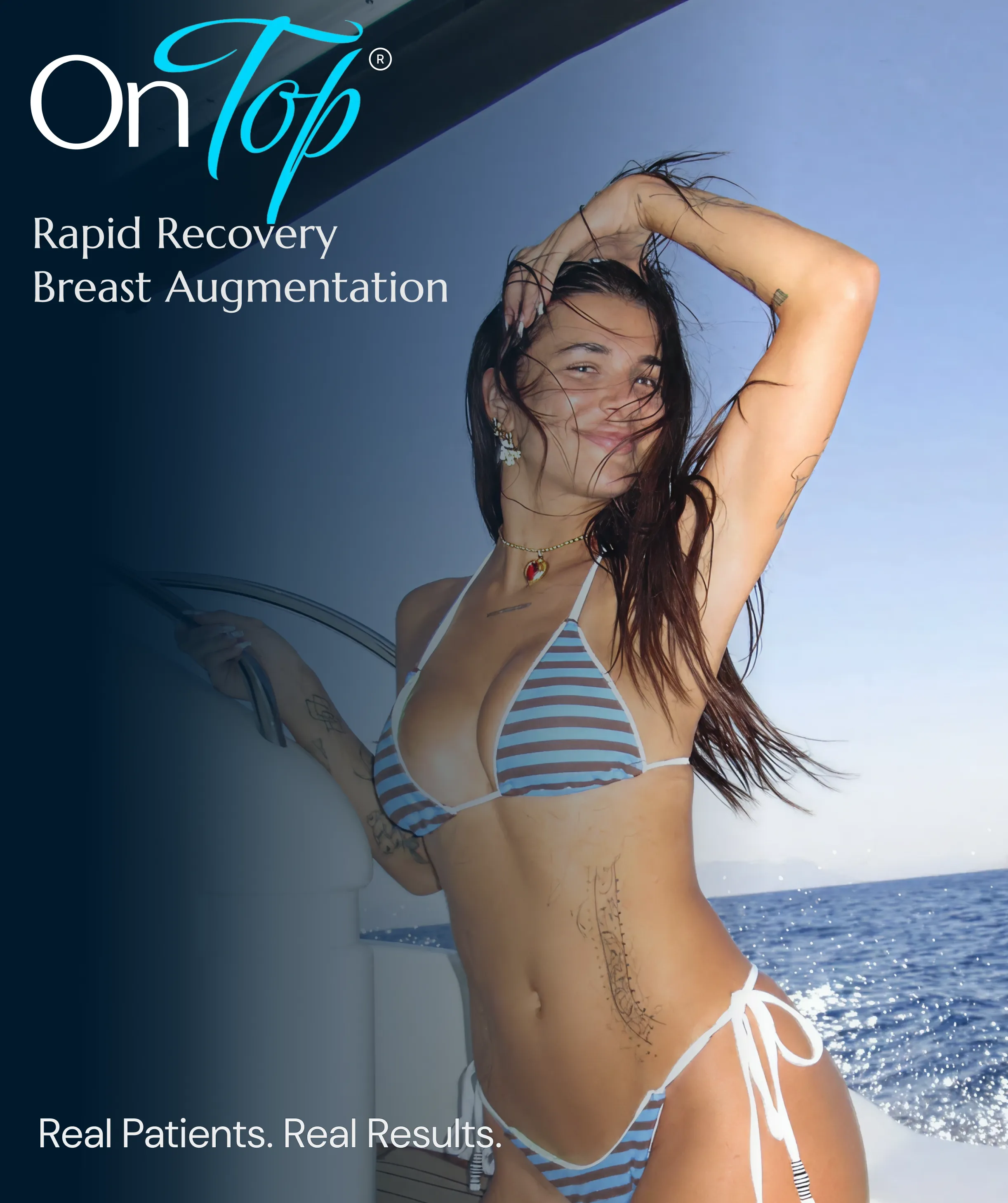
Our On Top® Rapid Recovery Breast Augmentation – which places implants above the muscle using the inframammary fold incision – is particularly well-suited for patients after weight loss. The above-muscle placement works naturally with the breast’s existing anatomy and doesn’t require cutting through chest muscle, which is important for patients who are focused on maintaining their activity level and recovery speed.

The Consultation Conversation
When a patient comes in asking about obesity and breast implants – or about whether their weight affects their candidacy – here’s how we approach that conversation:
First, we ask about health history, not just weight. BMI is a number; your health is a profile. The evaluation covers sleep apnea, cardiovascular history, diabetes, medications, and activity level. These factors – more than BMI alone – determine surgical risk.
Second, we ask about weight trajectory. Are you at a stable weight? Planning to lose more? Have you just completed a weight loss journey? The answer changes the recommendation.
Third, we talk about what to expect from the results specifically for your anatomy. This isn’t a generic conversation – it’s a specific one about how your breast tissue, your skin quality, and your proportional goals interact.
Finally, if timing isn’t ideal – if weight loss before surgery would significantly improve your safety profile or result quality – we say so. Patients who are told to lose weight first sometimes hear it as rejection. The intent is the opposite: it’s the recommendation that will get you the best result and the safest experience.
BREAST AUGMENTATION GALLERY
VIEW GALLERYFrequently Asked Questions
It depends on the degree of overweight and the individual’s health profile. Most plastic surgeons consider BMI over 35 a relative contraindication for elective breast augmentation due to elevated anesthesia and wound healing risks. Patients with BMI in the 30–35 range are evaluated individually based on their full health picture.
Yes. Implant size is always chosen relative to the patient’s anatomy – including chest width, existing breast tissue, and overall proportions. At higher weights, the chest base tends to be wider and existing breast tissue more substantial, which affects what size and profile of implant creates a natural result.
Significant weight loss after augmentation can affect the appearance of results – implants may become more prominent as surrounding fat tissue decreases, and skin laxity can increase. This doesn’t mean the implants are damaged or unsafe. It may mean revisiting the aesthetic result with your surgeon at a stable post-loss weight.
Combining procedures increases total anesthesia time and overall surgical risk. For patients whose weight is at or above the threshold where augmentation alone requires careful evaluation, combining procedures is generally not recommended. Safety is the first priority.
Most surgeons recommend six to twelve months of weight stability before elective breast augmentation. This allows the breast tissue – which continues to change after weight fluctuation – to reach a more predictable baseline.
Ready to Have an Honest Conversation?
Weight is one of many factors we discuss in a breast augmentation consultation – and it’s one we’re comfortable discussing directly, because being clear about it upfront leads to better outcomes for patients.
If you’re wondering whether your weight or your weight history affects your candidacy for breast augmentation, the most useful thing you can do is come in for a consultation. We’ll look at your specific anatomy, health profile, and goals – and give you a realistic, honest picture of what’s possible and when.
Schedule your consultation with Dr. Partington →
You can also learn more about the Motiva® implants we use and about the On Top® technique that makes our 24-hour recovery possible.
References
- American Society of Plastic Surgeons. “2022 Plastic Surgery Statistics Report.” PlasticSurgery.org.
- U.S. Food & Drug Administration. “Risks and Complications of Breast Implants.” FDA.gov. Updated 2022.
- Alderman AK, Collins ED, Schott A, et al. “The impact of breast implants on decision-making processes.” Plastic and Reconstructive Surgery. 2009;124(2):483-491.
- Mechanick JI, et al. “Clinical practice guidelines for perioperative nutritional and metabolic support of bariatric surgery patients.” Obesity. 2013;21(Suppl 1):S1-S27.
- National Heart, Lung, and Blood Institute. “Body Mass Index (BMI).” NHLBI.nih.gov.
